Montréal has a rich history of celebrating its LGBTA population and being at the forefront of the gay rights movement globally. The following is a brief timeline* that details many of the significant moments of past forty years.
1969 — By adopting the Omnibus bill, Pierre Elliott Trudeau’s government decriminalizes homosexuality. Prior to this, the majority of gay men and women in Quebec live in the shadows and in the closet, despite the popularity of few downtown gay bars. Montréal also has a few out local gay heroes including Armand Monroe, who got his name as the Marilyn Monroe impersonator “La Monroe”, in Montréal's Tropical Room of the Downbeat Club on Peel Street. In 1957, Armand demanded that gay staff be hired; on August 27, 1958, to mark his birthday, men were allowed to dance together for the very first time in a Montreal nightclub.3
1975-1976 — As part of an attempt to “clean up” the city prior to the Olympics, Mayor Jean Drapeau convenes a Public Morality Program aimed squarely at gay and Lesbian establishments. Beginning with the raid on the Aquarius Sauna in February 1975, many well-known establishments are targeted, including Club Baths (January 23, 1976) and Cristal Sauna (February 11, 1976). From the 14th to the 21st of March 1976, the Sauna Neptune, the Taureau d'Or, the Studio 1, the Stork Club and Jilly's, among others, are raided, fined and/or closed under often dubious charges. Many of the patrons and owners are arrested in what is, at the time, the largest mass arrests in Québec since the 1970 October Crisis.2
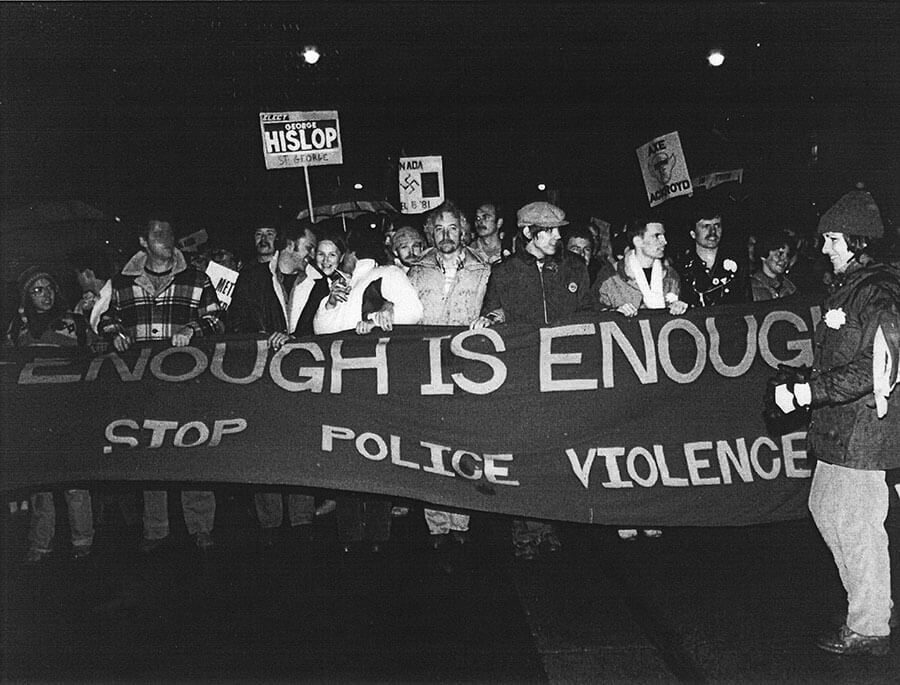
1977 — On October 21, over 140 gay men are arrested outside the Truxx bar. The following night, 2000 people take to the streets to protest these arrests and voice their anger. 2
1979-1980 — La Brigade Rose, a local community group, produces “Gairilla”, bringing together approximately 200 people to mark the 10th anniversary of the Stonewall Riots in New York City. A second edition is held the following year.1
1981-1986 — Different community groups begin to produce parades, first under the name “Gai-lon-la”, then “Marche Bleu Blanc Rose”, and always held towards the end of June. For a few years, the parade even falls under the banner of the “Fête Nationale”, since the June 24 date coincides with the Stonewall anniversary.1
1987-1990 — Parades continue to attract revellers, sometimes in the thousands, to celebrate Gay Pride on Sainte-Catherine Street East, between Saint-Hubert and Champlain Streets, in the heart of the Gay Village.1
1990 — July 15 is a momentous date in the history of Québec Gay Rights. When a group of overzealous Montréal police officers decide to violently break-up the « Sex Garage » party in Old Montréal, a series of events unfold, in what is widely-held as Montréal’s version of the Stonewall Riots. That night 400 primarily gay, lesbian and transgender revellers are taunted, brutalized and arrested while trying to leave the party. Enraged and no longer willing to settle for unfair targeting, giant protests occur on that same night and the night following outside MUC Station 25. Images of the brutality outside the « Sex Garage » party circulate around the globe and nearly three million Montrealers are finally made aware of the fear and conditions constantly faced by Montreal’s LGBTA population.
The events of July 15 lead to an investigation and a series of recommendations by the Human RIghts Commission and fosters in a new era of cooperation and mutual respect between a newly sensitized Montréal Police Force and the LGBTA Community. Today the MUC Police is considered an ally in combating homophobia and protecting our rights. Lastly, the « Sex Garage » protests also mobilizes the LGBTA community and opens the door to a new era of inclusiveness, particularly with respect to the transgender population.2
1993-2006 — Suzanne Girard (formerly an organizer of the Image+Nation LGBTA Film Festival) and Puelo Dier (an original organizer of the protests following Sex Garage Party) join together to form Divers/Cité, after no parade is held in 1992. Together, they grow the Divers/Cité parade from a mere 5000 people in its initial year to an estimated 200,000 in its 5th year. Divers/Cité continues to be an integral and internationally recognized part of gay life in Montréal and still organizes an important cultural festival that features many members of our impressive LGBTA community as well as international performers. The dates for Divers/Cité in 2007 are from August 1 to 5, the week following Célébrations LGBTA Montréal.1
2004 — On April 1, Michael Hendricks and René Leboeuf invite crowds to witness and celebrate the first legal Quebec gay marriage at the Montréal Palais de Justice, after a Québec Court of Appeals upholds, on March 19th, the Lemelin decision. On June 29th, the same-sex marriage legislation passes final reading in the House of Commons making Canada only the third country in the world, after the Netherlands and Belgium, to officially recognize same-sex marriage.4
2007 — Célébrations LGBTA Montréal, a newly formed, community-driven and not-for-profit organization, taking the reigns and proudly organized the Montréal Gay and Lesbian Community Day & Parade on July 28 & 29 2007. Célébrations LGBTA Montréal has been launched with the unprecedented support of members of Montréal’s LGBTA community. The 2007 edition launched many exciting new features including Grand Marshals, an Artistic Director, a theme as well a series of awards to highlight spirit and float-design.
For information:
Célébrations LGBTA Montréal
info@fiertemontrealpride.com
514 750-4492
* Information for, and portions of the text in, this timeline were adapted from:
The team at Célébrations LGBTA Montréal wish to sincerely thank these individuals for the permission to reprint these details.